Opinion
From Drone Warfare to Critical Minerals: India's Evolving Defence Priorities
The article examines how emerging technologies are transforming modern warfare and why India must strengthen its defence self-reliance to address evolving security challenges. Drawing on the observations of Chief of Defence Staff General NS Raja Subramani at the ANI National Security Summit 3.0, it highlights the growing importance of indigenous drone manufacturing, counter-drone systems, artificial intelligence, network-centric warfare and critical mineral supply chains. It also explores government initiatives such as Innovations for Defence Excellence (iDEX) and the National Critical Mineral Mission (NCMM), while examining challenges related to technological dependence, domestic manufacturing capacity, research funding and supply-chain resilience. The article argues that India's future military preparedness will depend not merely on acquiring advanced weapons platforms but on developing indigenous technologies, strengthening industrial capabilities and ensuring long-term strategic autonomy.
Background
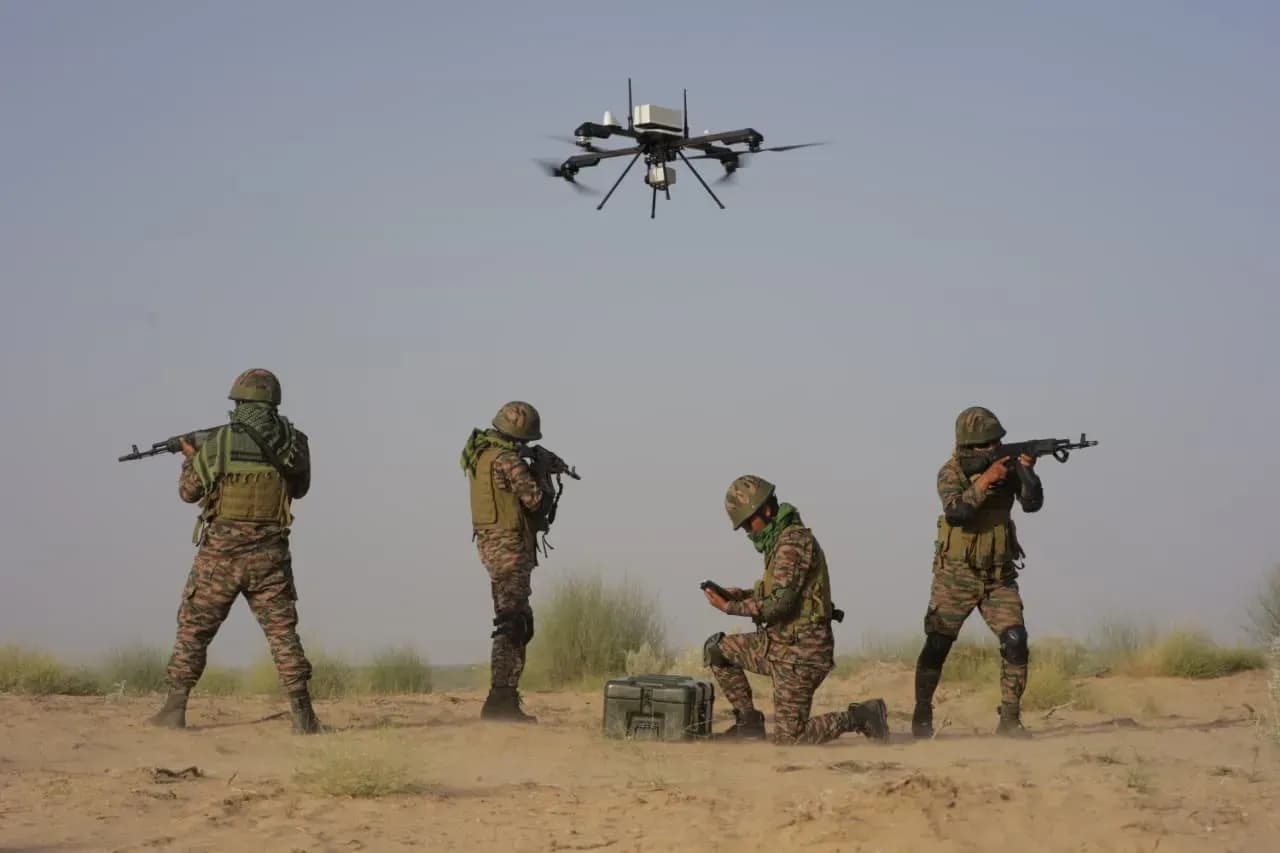
Modern warfare is undergoing a significant transformation. The growing use of unmanned aerial vehicles (UAVs), artificial intelligence (AI), satellite-based intelligence and network-centric military systems is changing how armed forces prepare for and conduct operations. Addressing the ANI National Security Summit 3.0 in New Delhi on 16 November 2026, Chief of Defence Staff (CDS) General NS Raja Subramani highlighted the changing economics of warfare, the growing competition for technological superiority and the expansion of the battlespace.
One of the major concerns with unmanned aerial vehicles is the financial imbalance between inexpensive offensive systems and costly defensive interceptors. When a military is required to use an expensive missile to neutralise a relatively inexpensive drone, the economic sustainability of its defence strategy becomes a concern.
This highlights the need for a layered approach combining sophisticated interceptors with more affordable counter-drone technologies. From drone manufacturing and AI-enabled decision-making to critical minerals and advanced electronics, India's future military capabilities will depend on the strength of this wider ecosystem.
The Role of Indigenous Drone Manufacturing and Counter-Drone Systems
Drones have become an important element of modern military operations because they provide relatively accessible surveillance and strike capabilities without exposing personnel to the same risks. Small UAVs can exploit gaps in conventional air-defence coverage, while coordinated drone attacks can place pressure on military installations and critical infrastructure. Therefore, the increasing use of drones also creates new vulnerabilities.
The government has also expanded innovation opportunities through the Innovations for Defence Excellence (iDEX) initiative. This initiative is intended to connect the operational requirements of the Armed Forces with solutions developed by domestic innovators. Approximately 676 start-ups, MSMEs and individual innovators have joined the defence innovation ecosystem since iDEX was established in 2018.
The priority for the nation should be to establish a complete drone ecosystem that includes indigenous flight-control systems, sensors, communication links, navigation technologies, propulsion systems, batteries and counter-UAS equipment.
Artificial Intelligence, Data and Network-Centric Warfare
Artificial intelligence is increasingly influencing military decision-making, intelligence analysis, surveillance, logistics and operational planning. Future military operations are likely to involve multiple interconnected platforms, including aircraft, drones, satellites, naval vessels, ground-based sensors and command centres. Their effectiveness will depend on the ability to share accurate information securely and in real time. In this environment, data becomes a strategic military resource.
AI-enabled tools can assist in identifying potential threats, analysing satellite imagery, supporting logistics and improving situational awareness. In October 2024, the Ministry of Defence introduced the Evaluating Trustworthy Artificial Intelligence (ETAI) Framework and Guidelines for the Armed Forces. The framework identifies reliability, robustness, safety, security, transparency, fairness and privacy as important principles for integrating AI into critical defence operations.
The Indian Army has also demonstrated indigenous AI applications. During its Vijay Diwas 'At Home' event in December 2025, it showcased a portable AI system designed to function in areas without internet connectivity, and Ekam AI, which is an indigenous platform intended to support secure information analysis and decision-making. These developments indicate that India's AI efforts are moving beyond policy discussions towards practical military applications.
Critical Minerals: The Industrial Foundation of Defence Self-Reliance
While discussions on military technology generally focus on aircraft, missiles, drones and electronic systems, the production of these platforms also depends on specialised raw materials and components. Critical minerals and rare-earth elements are important for several advanced industrial and defence applications. Rare-earth permanent magnets, for instance, are used in aerospace systems, defence equipment, precision sensors and other advanced engineering applications.
The strategic concern is not simply whether a country possesses mineral reserves, but whether it has the technological and industrial capacity to extract, process, refine and manufacture components from those resources. Dependence on a limited number of external suppliers can create vulnerabilities, particularly during geopolitical tensions or disruptions to international trade. India has recognised this challenge through the National Critical Mineral Mission (NCMM), launched in 2025.
The mission aims to strengthen domestic and overseas sourcing, mineral exploration, processing, recycling and research. The mission also seeks to strengthen the broader value chain through technological development and greater domestic processing capacity. Dedicated rare-earth corridors were also announced in Odisha, Kerala, Andhra Pradesh and Tamil Nadu to promote mining, processing, research and manufacturing. The scale of India's import dependence makes this effort strategically important because India is dependent on China for rare-earth permanent magnet imports.
Challenges
Despite progress in defence indigenisation, several challenges could affect India's ability to translate these priorities into sustainable military capabilities. One of the major challenges is to develop domestic design, manufacturing and intellectual property capabilities rather than merely assemble imported components. India will also need to diversify overseas sourcing partnerships and strengthen recycling capabilities to reduce supply-chain risks.
India's defence industry must develop the production capacity to meet military requirements during both peacetime and prolonged conflicts. This will require stronger supply chains, standardised components and closer cooperation between large defence manufacturers, MSMEs and start-ups. Military AI systems must function accurately in complex and contested environments. Poor-quality data, cyberattacks, communication disruptions and vulnerabilities in software can undermine their effectiveness.
Developing advanced defence technologies requires sustained research funding, specialised technical expertise and effective collaboration between the Armed Forces, DRDO, academic institutions and private industry. These challenges demonstrate that defence self-reliance is not an immediate procurement objective but a long-term process.
Conclusion
The changing character of warfare is redefining the foundations of military power. The growing role of drones, artificial intelligence, data, satellite systems and advanced materials demonstrates that future military preparedness will depend on more than the possession of sophisticated weapon platforms. It will require the ability to develop technologies, manufacture critical components, maintain resilient supply chains and adapt rapidly to emerging threats.
India must move beyond domestic assembly towards greater control over design, intellectual property, advanced materials, software and manufacturing processes. It must also ensure that innovations developed by research institutions and start-ups can be tested, scaled and integrated into operational military systems.
Ultimately, defence self-reliance should not be understood as complete isolation from international technology markets. It should provide India with the freedom to make strategic decisions, the capability to act independently when required and the industrial resilience to sustain military operations during prolonged crises. In the emerging era of technology-driven warfare, these capabilities will be central to India's long-term strategic autonomy.
References
Department of Defence Production. (n.d.). iDEX products. https://www.ddpmod.gov.in/en/offerings/schemes-and-services/idex/products
Indian Army. (2026). Annual report 2025–26. Ministry of Defence, Government of India. https://www.dodmod.gov.in/static/uploads/2026/09/a7246d934eda1e2d031293822d4a323f.pdf
Ministry of Defence. (2024, October 17). Framework and guidelines to integrate trustworthy AI into critical defence operations unveiled. Press Information Bureau. https://www.pib.gov.in/PressReleseDetailm.aspx?PRID=2065847&lang=2®=3
Ministry of Defence. (2025a, August 24). DRDO successfully conducts maiden flight tests of Integrated Air Defence Weapon System. Press Information Bureau. https://www.pib.gov.in/PressReleaseIframePage.aspx?PRID=2160257&lang=2®=48
Ministry of Defence. (2025b, May 31). Indian Army conducts trials of next-gen defence technologies under simulated operational conditions. Press Information Bureau. https://www.pib.gov.in/PressReleasePage.aspx?PRID=2132979&lang=2®=48
Ministry of Defence. (2025c, November 1). Indian Army conducts ‘Vayu Samanvay-II’, a major drone and counter-drone exercise in desert sector. Press Information Bureau. https://www.pib.gov.in/PressReleasePage.aspx?PRID=2185226&lang=2®=48
Ministry of Defence. (2025d, July 16). Operation Sindoor demonstrated operational effectiveness and strategic value of indigenous unmanned aerial vehicles and counter-unmanned aircraft systems, says Chief of Defence Staff. Press Information Bureau. https://www.pib.gov.in/PressReleaseIframePage.aspx?PRID=2145420&lang=2®=48
Ministry of Defence. (2026, August 18). Aatmanirbhar Bharat: DDP notifies 6th Positive Indigenisation List of 405 strategically important items. Press Information Bureau. https://www.pib.gov.in/PressReleaseIframePage.aspx?PRID=2300723&lang=1®=3
Ministry of Defence. (2025). Annual report 2024–25. Government of India. https://www.dodmod.gov.in/static/uploads/2026/02/09e57ee6fe0839b19ae2c8ff7c871246.pdf
Ministry of Earth Sciences. (2026, April 2). Parliament question: Rare earth reserves and magnet manufacturing. Press Information Bureau. https://www.pib.gov.in/PressReleasePage.aspx?PRID=2248182&lang=1®=3
Ministry of Mines. (2025, March 24). Strategic supply chain management for critical minerals. Press Information Bureau. https://www.pib.gov.in/PressReleasePage.aspx?PRID=2114467&lang=2®=3
Department-related Parliamentary Standing Committee on Industry, Rajya Sabha. (2026). 332nd report on demands for grants (2026–27) of the Ministry of Heavy Industries. Parliament of India. https://sansad.in/getFile/rsnew/Committee_site/Committee_File/ReportFile/17/215/332_2026_3_14.pdf?source=rajyasabha
More to read
Defence
India–US Defence Partnership: How Joint Manufacturing and Ship Repairs Are Creating New Business Opportunities
Defence
India's Defence Industry Gets a Titanium Boost as PTC Industries Secures 400-Tonne Order

Defence