Opinion
L&T's ₹5,000 Crore AI Bet: How NVIDIA-Powered Computing Could Strengthen India's Digital Economy
Larsen & Toubro (L&T), through its group company Vyoma.AI and subsidiary LTN Compute, has secured a multi-year AI infrastructure engagement classified as a ₹2,500–5,000 crore 'Large' order to deploy additional NVIDIA B300 GPUs at its Chennai data centre. The development builds on L&T's broader plan to establish a 10,000-GPU AI Factory in partnership with Together AI, positioning the company to tap into India's growing demand for advanced AI computing. With India's data centre capacity expanding and electricity demand from these facilities projected to rise significantly, the project highlights the economic opportunities emerging across data centres, power infrastructure, cooling systems and high-performance computing. It also reflects India's ambition to strengthen its AI ecosystem through private investment and government initiatives such as the IndiaAI Mission, while raising important questions about energy consumption, capital costs and the long-term profitability of AI infrastructure.
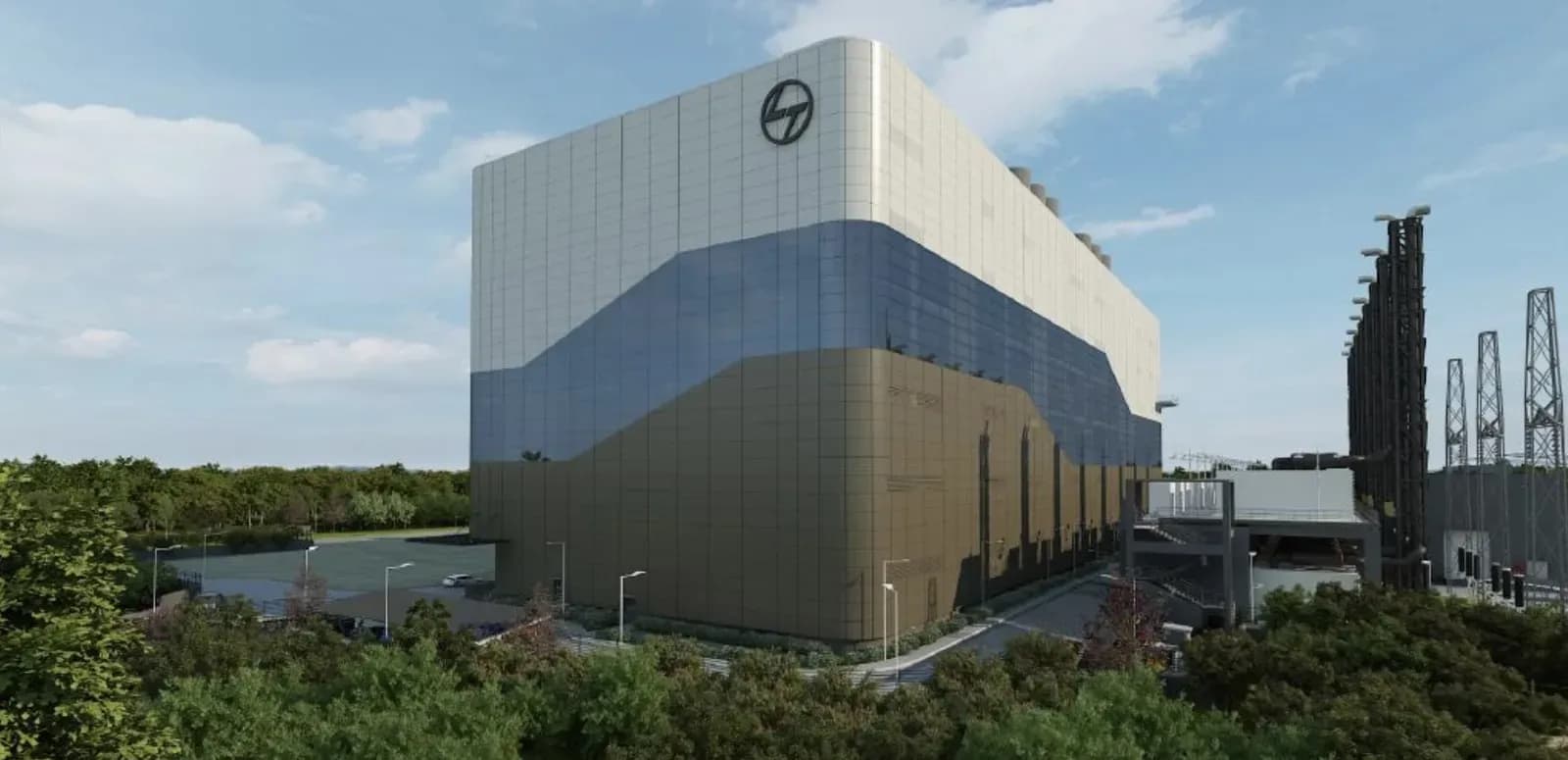
India's AI infrastructure race is entering a new phase as Larsen & Toubro expands its Chennai computing facility, highlighting the growing economic importance of data centres, GPU capacity and high-performance computing.
The AI infrastructure opportunity behind L&T's latest order
Artificial intelligence is increasingly becoming an infrastructure-intensive industry, requiring enormous computing power, specialised processors and reliable electricity. Recognising this opportunity, Larsen & Toubro (L&T) is strengthening its presence in India's rapidly developing AI infrastructure market.
On November 23, L&T announced that its group company, Vyoma.AI, through its AI infrastructure subsidiary LTN Compute, had secured a multi-year engagement with an unnamed AI inference infrastructure provider. The agreement involves deploying additional NVIDIA B300 graphics processing units (GPUs) at its Chennai data centre.
L&T classified the contract as a 'Large' order, a category covering projects valued between ₹2,500 crore and ₹5,000 crore under the company's internal order classification system. However, the company has not disclosed the exact contract value.
The announcement is significant not merely because of its financial scale, but because it reflects a broader shift in India's technology industry: the transition from developing AI applications to building the computing infrastructure required to operate them at commercial scale.
What is L&T actually building?
The latest engagement forms part of a larger AI infrastructure initiative at Vyoma.AI's Chennai campus.
In August 2026, L&T announced a strategic partnership with US-based AI cloud company Together AI to establish an AI Factory with a planned capacity of 10,000 NVIDIA B300 GPUs. The facility is intended to support large-scale AI training, fine-tuning and inference workloads.
The November announcement represents an additional GPU deployment engagement within this broader cluster. L&T has not specified the exact number of additional GPUs covered by the latest announcement.
The facility is being developed as a gigawatt-scale AI infrastructure hub, with its first phase designed for 250 megawatts (MW). L&T has also stated that 150 megavolt-amperes (MVA) of power infrastructure is ready to support the development.
An AI Factory is fundamentally different from a conventional data centre. While traditional facilities primarily store, process and manage digital information, AI Factories integrate specialised processors, high-speed networking, advanced storage and computing infrastructure to handle demanding artificial intelligence workloads.
This infrastructure enables businesses to train models, customise existing AI systems and operate AI applications at scale.
Why NVIDIA B300 GPUs matter to the business model
At the centre of L&T's project are NVIDIA's B300 GPUs, specialised processors designed for demanding AI computing workloads.
Unlike conventional computing infrastructure, AI systems require substantial parallel processing capabilities. GPUs help execute multiple calculations simultaneously, making them particularly useful for training and running large AI models.
The commercial opportunity extends beyond simply owning computing hardware. Companies can monetise this infrastructure through services such as GPU-as-a-Service (GPUaaS), which allows businesses, researchers and developers to access computing capacity without purchasing and maintaining expensive GPU systems themselves.
For L&T, this creates an opportunity to develop recurring technology-service revenues alongside its traditional engineering and infrastructure businesses.
The company's broader digital infrastructure portfolio includes hyperscale data centres, sovereign cloud platforms, AI Factory services, Bare Metal-as-a-Service and managed AI platforms.
However, the financial returns from this business will depend on factors such as utilisation rates, customer demand, electricity costs, hardware investment and the ability to secure long-term commercial engagements.
India's AI ambitions come with an enormous power requirement
The expansion of AI infrastructure also raises an important economic question: can India's electricity infrastructure support the computing industry's growing requirements?
According to a March 2026 response by the Ministry of Electronics and Information Technology in the Rajya Sabha, India's total data centre capacity increased from approximately 375 MW in 2020 to around 1,500 MW by 2025.
More importantly, information provided by the Ministry of Power estimated that electricity demand from data centres could reach 13.56 GW by 2031–32.
This projected demand highlights the growing relationship between India's digital economy and its power sector.
Large AI computing facilities require reliable, uninterrupted electricity to operate servers and cooling systems. Consequently, the expansion of AI infrastructure could create opportunities for power generation companies, transmission infrastructure providers, cooling technology manufacturers and specialised equipment suppliers.
It also makes energy efficiency and the availability of reliable electricity important factors in determining the long-term competitiveness of Indian data centres.
Can India become a global AI computing destination?
The government's IndiaAI Mission is another important part of this developing ecosystem.
With an approved financial outlay of approximately ₹10,372 crore, the mission aims to strengthen India's AI capabilities through computing infrastructure, innovation, research and wider access to AI resources.
According to a Press Information Bureau update, India's shared AI computing capacity had expanded to more than 45,000 GPUs by June 2026. By August 2026, 237 projects had accessed subsidised computing resources through the initiative.
These developments indicate that India's AI strategy is not limited to software development. Access to computing infrastructure is becoming an important part of its technology and industrial policy.
Private-sector investments such as L&T's Chennai AI Factory could complement these public initiatives by expanding commercial computing capacity and attracting enterprises that require specialised infrastructure.
Nevertheless, becoming a global AI computing destination will require more than installing advanced processors. India will need competitive electricity costs, reliable infrastructure, skilled professionals, strong data governance and sustained demand from domestic and international customers.
The bigger economic picture
L&T's latest AI infrastructure engagement illustrates how artificial intelligence is creating investment opportunities beyond software companies and technology startups.
Data centres, GPUs, networking equipment, power infrastructure and cooling systems are becoming increasingly important components of the AI economy.
For India, the opportunity lies in building the physical infrastructure that supports the next generation of digital services, industrial automation and enterprise AI adoption.
Yet, the scale of investment also brings commercial risks. High capital expenditure, rapidly evolving processor technology, power consumption and uncertain utilisation levels could influence the profitability of AI infrastructure projects.
Ultimately, L&T's Chennai project will be judged not only by the computing capacity it installs, but also by how effectively it converts that capacity into sustainable business revenues.
India's AI race is therefore no longer just about developing smarter algorithms. It is increasingly about who can build, power and commercially operate the infrastructure behind them.