Opinion
India–South Korea Maritime Cooperation: INS Sahyadri's Naval Engagement at Busan
The article examines the growing maritime and defence partnership between India and South Korea, focusing on INS Sahyadri's participation in the India–Republic of Korea Navy Bilateral Exercise at Busan in October 2026. It highlights the strategic importance of the exercise in strengthening naval interoperability, operational coordination and maritime security across the Indo-Pacific. The article also explores the broader defence relationship between the two countries, including defence manufacturing cooperation, technology partnerships and India's Act East Policy, while examining shared concerns over regional security and China's expanding naval presence. It discusses challenges arising from differing strategic priorities, technology transfer and geopolitical considerations. Ultimately, it argues that sustained naval exercises, maritime information-sharing and defence industrial collaboration can strengthen India's regional maritime presence and contribute to a stable, secure and rules-based Indo-Pacific.
Background
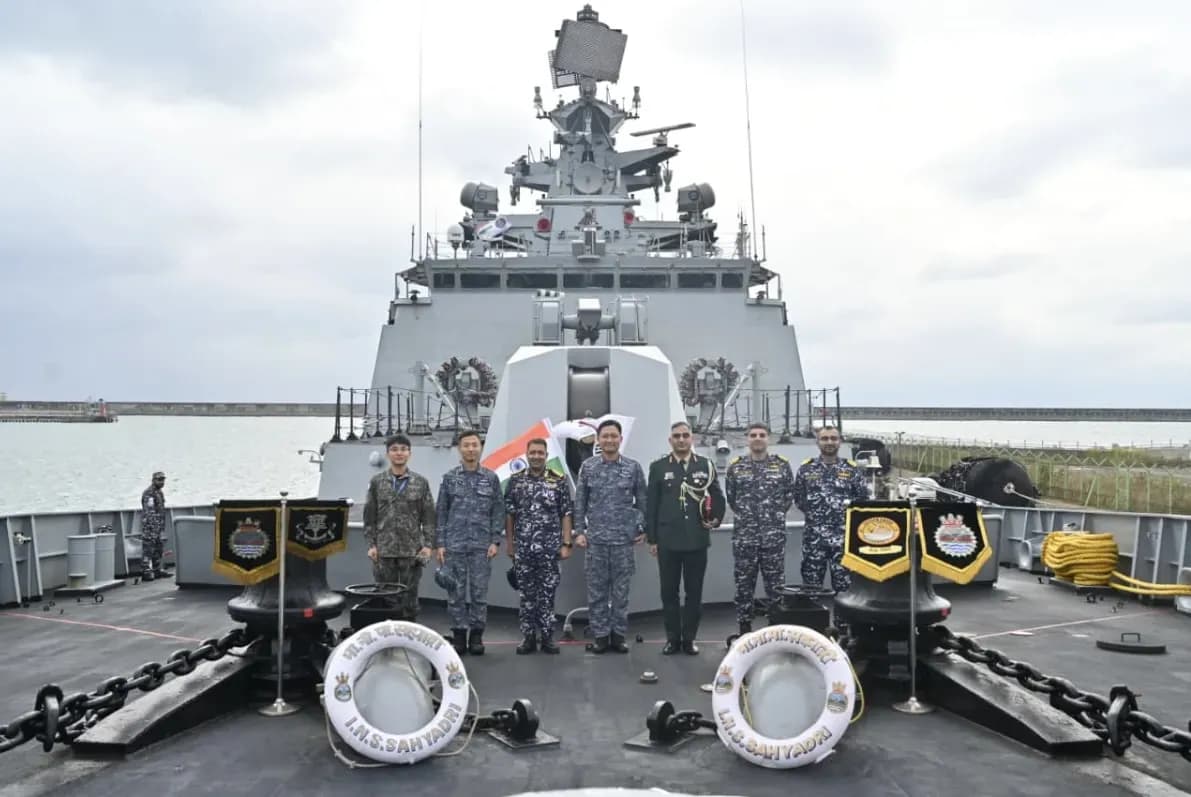
The indigenously designed guided-missile stealth frigate of the Indian Navy, INS Sahyadri, arrived at Busan Naval Harbour in the Republic of Korea to participate in the India–Republic of Korea Navy (IN–RoKN) Bilateral Exercise on 26th October 2026. This marked another milestone in the expanding maritime partnership between the two countries. The bilateral exercise, which concluded on 29 October 2026, involved two phases: Harbour phase and Sea phase.
The Harbour phase facilitated the exchange of operational experiences and best practices with Indian and South Korean Naval personnel participating in professional discussions, cross-deck visits, operational briefings, subject matter expert exchanges and sporting activities.
During the Sea phase, INS Sahyadri and South Korea's ROKS Munmu The Great undertook coordinated navigation, helicopter operations and joint maritime manoeuvres, which provided an opportunity to improve operational coordination and develop a better understanding of each other's naval procedures. The exercise demonstrates the growing willingness of both countries to strengthen maritime cooperation and contribute to peace, stability and security in the Indo-Pacific.
India and the Republic of Korea have gradually expanded their bilateral relationship to defence, maritime security and technology beyond conventional trade and economic cooperation. The relationship between the two countries was elevated to a Special Strategic Partnership in 2015, providing a broader framework for cooperation across political, economic, security and defence sectors.
Both countries recognise the importance of technological collaboration, defence manufacturing and maritime security. Therefore, defence cooperation has increasingly become an important component of this partnership. India and South Korea signed a roadmap for defence industries cooperation in September 2020, which aims to promote collaboration between defence industries, encourage joint ventures and facilitate technology partnerships.
The K9 Vajra-T self-propelled artillery system developed through collaboration between South Korea's Hanwha Aerospace and India's Larsen & Toubro (L&T) is one of the most significant examples of India–South Korea defence industrial cooperation; the programme demonstrates how foreign defence technology can be adapted and manufactured in India. In April 2025, a contract for an additional 100 K9 Vajra artillery systems was signed, further strengthening this industrial partnership.
Naval cooperation has also expanded through port visits, naval exchanges and joint exercises. The two countries have also strengthened coast guard cooperation, including a Memorandum of Understanding on Maritime Search and Rescue signed in July 2025. The participation of INS Sahyadri and South Korea's ROKS Nojeokbong in October 2025 marked the inauguration of the India–Republic of Korea bilateral naval exercise. Against this background, the October 2026 engagement at Busan represents the continuation of a growing defence relationship, moving beyond diplomatic exchanges towards practical maritime cooperation.
Strategic Significance
The Indo-Pacific has emerged as a major theatre of geopolitical competition, with growing naval deployments, maritime disputes and competition over strategic sea routes.INS Sahyadri's deployment reflects the Indian Navy's ability to conduct long-distance operational deployments. India's participation in the exercise demonstrates its willingness to engage with regional partners and maintain a credible maritime presence beyond the Indian Ocean.
Interoperability is essential to provide practical experience in coordinating naval activities, particularly during humanitarian assistance, disaster relief, search-and-rescue missions and maritime security operations. The joint navigation, helicopter operations and maritime manoeuvres undertaken by INS Sahyadri and ROKS Munmu The Great help develop familiarity with communication procedures, operational practices and coordination requirements.
INS Sahyadri, which was commissioned in 2012, is particularly significant because it represents India's indigenous warship-building capabilities. It is the third vessel of the Shivalik-class guided-missile stealth frigates. Its deployment demonstrates that India's indigenous-made warships can participate in bilateral and multilateral naval engagements. This strengthens India's ambition to become not only a defence equipment manufacturer but also a reliable maritime partner and net security provider
India's defence engagement with South Korea provides opportunities to diversify its strategic and technological partnerships. South Korea possesses considerable capabilities in shipbuilding, naval platforms, artillery systems, defence electronics and advanced manufacturing. Closer cooperation can create opportunities for Indian defence industries, particularly in shipbuilding, maintenance, repair and overhaul (MRO), and emerging maritime technologies.
Geopolitical Implications
The exercise assumes significance amid changing maritime security dynamics in the Indo-Pacific, particularly the growing strategic competition involving China. India and South Korea share an interest in maintaining an open, stable and rules-based Indo-Pacific. Their naval engagement contributes to regional confidence-building and strengthens cooperation between two important Asian maritime powers. China's expanding naval capabilities and increasing maritime presence have encouraged regional countries to strengthen their defence partnerships.
Engaging with South Korea complements India's Act East Policy by extending strategic engagement beyond economic and diplomatic relations into practical defence cooperation. Stronger naval engagement with Seoul creates an additional channel of cooperation in East Asian maritime security. South Korea occupies an important strategic position in Northeast Asia, particularly because of its geographical proximity to the Korean Peninsula and the East China Sea.
Both countries participate in regional and multilateral platforms, including the East Asia Summit and the ASEAN Regional Forum. India and South Korea's growing defence relationship creates opportunities for wider cooperation with other regional partners. Although the bilateral Naval exercise is not a multilateral security arrangement, it contributes to a broader regional environment in which countries increasingly rely on maritime cooperation and information sharing.
The Indo-Pacific contains critical international shipping routes connecting the Indian Ocean with East and Southeast Asia. Disruptions to these routes can affect energy supplies, international trade and economic stability. Meanwhile, greater Naval cooperation between India and South Korea can contribute to maritime domain awareness, coordinated responses to maritime emergencies and the protection of international shipping interests.
Challenges
India–South Korea maritime cooperation faces several challenges, such as differences in strategic priorities. India's primary maritime security interests are concentrated in the Indian Ocean, while South Korea's immediate security priorities are strongly influenced by the Korean Peninsula and Northeast Asian security environment. South Korea's advanced defence manufacturing capabilities offer significant opportunities for India, but deeper industrial cooperation might face complications due to differences in intellectual property arrangements, technology transfer requirements, procurement policies and domestic manufacturing priorities.
Geopolitical sensitivities are another limitation, as India and South Korea maintain different strategic relationships with major powers, including the United States, China and Russia. Diplomatic and security priorities of both countries may influence the scope of defence cooperation. India must therefore maintain its strategic autonomy while developing stronger partnerships with regional countries.
Conclusion
The India–South Korea naval engagement reflects India's broader approach towards strengthening maritime partnerships, enhancing naval interoperability and expanding its strategic engagement across the Indo-Pacific rather than just a routine bilateral military exercise. The participation of INS Sahyadri demonstrates the operational capabilities of India's indigenous naval platforms. For India, the next step should be to translate these engagements into sustained cooperation through regular bilateral exercises, maritime information-sharing, defence technology partnerships and greater collaboration in shipbuilding and naval systems.
India should also explore opportunities for cooperation in anti-submarine warfare, maritime surveillance, unmanned maritime systems and maritime domain awareness, subject to mutual interests and technological feasibility. Ultimately, stronger maritime cooperation with South Korea can contribute to India's long-term objective of developing a technologically capable, operationally prepared and strategically connected navy. As the Indo-Pacific continues to evolve as a centre of geopolitical and economic competition, partnerships such as this will remain important in strengthening India's position as a responsible maritime stakeholder.
References
- Press Information Bureau, Ministry of Defence. (2026, November 3). INS Sahyadri concludes India–Republic of Korea Navy bilateral exercise at Busan. Government of India. https://www.pib.gov.in/PressReleasePage.aspx?PRID=2332012
- Press Information Bureau, Ministry of Defence. (2026, October 28). INS Sahyadri arrives at Busan, Republic of Korea, for India-RoKN bilateral exercise. Government of India. https://www.pib.gov.in/PressReleseDetailm.aspx?PRID=2329562
- Press Information Bureau, Ministry of Defence. (2025, October 14). Inaugural edition of the India–Republic of Korea Navy bilateral exercise. Government of India. https://www.pib.gov.in/PressReleasePage.aspx?PRID=2179047
- Press Information Bureau, Ministry of Defence. (2026, May 20). Raksha Mantri holds bilateral talks with the Minister of National Defence, Republic of Korea in Seoul. Government of India. https://www.pib.gov.in/PressReleasePage.aspx?PRID=2263304
- Press Information Bureau, Ministry of Defence. (2025, July 21). 13th High-Level Meeting between Indian Coast Guard and Korea Coast Guard held in New Delhi. Government of India. https://www.pib.gov.in/PressReleasePage.aspx?PRID=2146622
- Press Information Bureau, Ministry of Defence. (2025, December). Surface fleet and shipbuilding. Government of India. https://static.pib.gov.in/WriteReadData/specificdocs/documents/2025/dec/doc2025123716101.pdf
- Press Information Bureau, Ministry of Defence. (2015, October 23). Visit of INS Sahyadri to Incheon, Republic of Korea. Government of India. https://www.pib.gov.in/newsite/PrintRelease.aspx?lang=2®=3&relid=129917
- Embassy of India, Seoul. (n.d.). Inaugural edition of the India–Republic of Korea Navy bilateral exercise. Ministry of External Affairs, Government of India. https://indembassyseoul.gov.in/listview/Mzcx
- DD India. (2026, November 3). INS Sahyadri concludes India-South Korea naval exercise at Busan. https://ddindia.co.in/2026/11/ins-sahyadri-concludes-india-south-korea-naval-exercise-at-busan/
- DD India. (2026, October 28). INS Sahyadri’s South Korea visit to strengthen Indo-Pacific maritime cooperation. https://ddindia.co.in/2026/10/ins-sahyadris-south-korea-visit-to-strengthen-indo-pacific-maritime-cooperation/
More to read
Defence
India–US Defence Partnership: How Joint Manufacturing and Ship Repairs Are Creating New Business Opportunities

Defence
India's Defence Industry Gets a Titanium Boost as PTC Industries Secures 400-Tonne Order
Defence